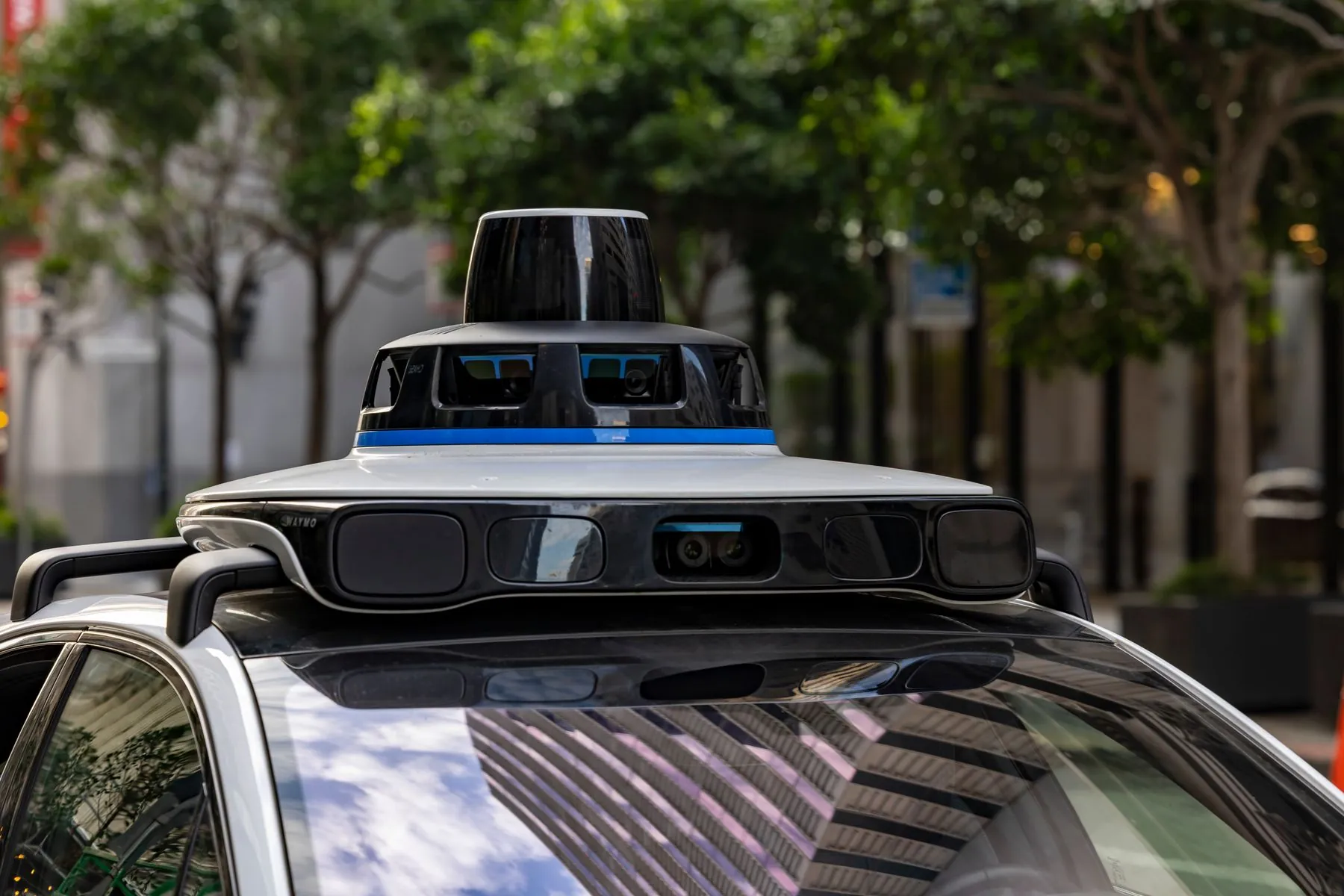
Stand next to a self-driving car and you will often see a spinning dome on the roof. That is the lidar — and it does not "see" the street the way a camera does. It measures it.
Light, timed very precisely
Lidar stands for light detection and ranging. The sensor fires short pulses of invisible infrared laser light and times how long each one takes to bounce back. Light travels about 30 centimetres per nanosecond, so a pulse that returns after 200 nanoseconds hit something roughly 30 metres away.
A modern automotive lidar does this hundreds of thousands of times per second, sweeping its beams across the scene. Every return becomes a single point in 3D space. Put them together and you get a point cloud: a cloud of dots that traces the shape of every car, kerb, lamp post and person nearby.
What a point cloud is good at
- Exact distance. Cameras have to estimate depth; lidar measures it directly, to within a few centimetres.
- Shape. A cyclist and a pedestrian have very different silhouettes in 3D, even at night.
- Darkness. Lidar brings its own light, so a dark street looks almost the same as a bright one.
What it is not good at
A point cloud has no colour. Lidar cannot read a traffic light, a road sign or brake lights. It also gets noisier in heavy rain, fog and snow, when droplets reflect some of the pulses back early. That is why no serious driving system relies on lidar alone.
Cameras tell you what something is. Lidar tells you exactly where it is. Radar tells you how fast it is moving. You want all three.
From dots to objects
Raw points are not much use to a planner. Drivora's perception models group nearby points into objects, match them with what the cameras see, and draw a 3D box around each one: this is a pedestrian, 1.7 m tall, 14 m ahead, walking left at 1.2 m/s. That box is updated every frame, so each object gets a track — a short history of where it has been, which the prediction model uses to guess where it is going next.
Why it matters for fleets
For an operator, the practical benefit is consistency. A lidar-equipped vehicle measures the world the same way at 3 a.m. as at noon, which is exactly what a night-shift delivery loop or a 24-hour yard needs.